 By Mari Hansen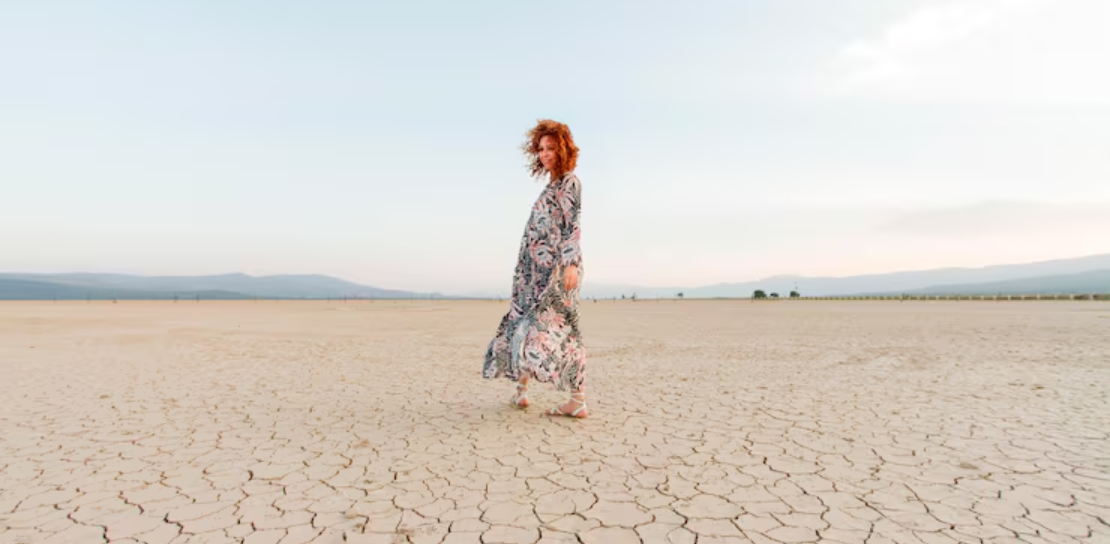
It seems like a longer drive to La Junquera than it actually is. Only obstinate almond trees clinging to the ground break up the dry hills that stretch outward, their colors fading somewhere between brown and ash. It’s difficult to ignore how quiet it is. Not tranquil. Simply emptied.
Alfonso Chico de Guzmán is attempting to undo something that is difficult to undo here in southeast Spain. His family has owned his 1,000-hectare farm for many generations. However, when you walk across some of it now and dig a few inches down, you find something unsettling: bedrock where soil should be.
| Category | Details |
|---|---|
| Region | Spain (especially Murcia, southeastern regions) |
| Key Figure | Alfonso Chico de Guzmán (Regenerative farmer) |
| Climate Projection | +2°C or more by end of century |
| Desertification Risk | ~75% of Spain affected; up to 90% in Murcia |
| Water Crisis | Reservoirs in Murcia ~21% capacity |
| Soil Loss | 40–50 tons/hectare/year in some areas |
| Key Institutions | European Commission, European Environment Agency |
| Scientific Warning | Madrid climate may resemble Marrakesh by 2050 |
| Reference | https://climate.ec.europa.eu |
That particular detail sticks. After all, soil is meant to be patient. constructed gradually over centuries, layer by layer. And yet, in a matter of decades, it has vanished.
There seems to be more going on here than just local mismanagement or bad luck. The figures point to something bigger and more elusive. By the end of the century, temperatures in Spain could increase by more than 2°C, according to climate projections from the European Commission. On paper, that sounds modest. However, in this area, it means that crops are struggling to survive, reservoirs are running low, and the earth is cracked.
La Junquera’s surrounding region, Murcia, is already experiencing hardship. There is a high or very high risk of desertification on nearly 90% of its land. The capacity of reservoirs is about 21%, which is less than half of the national average. There is a subtle tension as farmers look up at the sky, as if they are waiting for something that might not materialize.
When Chico de Guzmán took over the farm in 2012, he was unable to wait. He started experimenting, planting pistachios and almonds, switching to organic farming, and creating swales in the ground to collect water. The modifications, which are based on methods from before industrial agriculture reduced complexity to efficiency, seem almost antiquated.
This return to traditional farming practices may reveal something unsettling about contemporary farming. It turns out that efficiency can deplete land more quickly than it can replenish it. For the time being, his slower and more labor-intensive method appears to be effective. His goods are more expensive. Even so, he acknowledges that the math is unsettling. On some of his land, soil loss can reach 50 tons per hectare annually. That is not a gradual decline. That is an urgent form of erosion.
Another farmer in Chirivel, 70 kilometers away, is making her own adjustments. As she strolls through her almond groves, Santiaga Sánchez Porcel gestures to the ground beneath the trees rather than the trees themselves. The soil is darker and retains moisture in areas with green cover, such as vegetables and grains. It appears worn out where there isn’t.
In what she refers to as a “circular system,” her sheep graze and fertilize simultaneously as they move across the fields. It’s useful. Almost refined. Nevertheless, there is uncertainty even here. “When it should be cold, it’s not,” she claims. Trees have early blooms. Cycles are blurry, and frost comes late.
Perhaps the most telling sign is that discrepancy between reality and expectations. In addition to raising temperatures, climate change also modifies timing, which confuses rhythm-dependent ecosystems. Scientists caution that by the middle of the century, cities like Madrid may start to resemble Marrakesh if emissions are not reduced. Summers are hotter. Rainfall is less predictable. More strain on systems that are already vulnerable.
It’s not just drought, either. When it does fall, it frequently does so with great force, erasing centuries’ worth of topsoil. It’s an odd paradox: too little water most of the time, but too much when it does show up.
According to researchers at the European Environment Agency, summertime precipitation in some areas of Spain may decrease by over 40%. Harvests are not the only thing that are decreased by such a change. It modifies the terrain.
This story also has a more subdued side. Deserts in the traditional sense are not created by desertification. It results in land that appears to be alive but isn’t working properly, which is perhaps worse. little vegetation. bad soil. delicate ecosystems.
It’s a sort of ecological limbo, according to Almería researcher Gabriel del Barrio. Not quite dead. Not really alive.
That thought persists. Because it implies that something vital might already be lost even if the land seems to be recovering.
Naturally, the core of this is human activity. excessive water use. removal of the vegetation. Land is being pushed beyond its limits by intensive agriculture. Climate change accelerates processes that are already underway rather than acting as a root cause.
The human cost comes next. People depart when land becomes less productive. Spain’s interior areas are already becoming “demographic deserts,” according to some researchers. Villages are deserted. Economies contract. Whether regenerative initiatives can grow quickly enough to buck this trend is still up for debate.
There is a sense that Spain is serving as Europe’s early warning system as this develops. What takes place here might not remain here.
Similar trends—rising temperatures, unpredictable rainfall, and stressed ecosystems—are beginning to appear throughout the Mediterranean basin. Research points to changes that haven’t occurred in 10,000 years. It’s hard to understand that completely.
Nevertheless, the abstraction disappears when one is in a location such as La Junquera. The dust rising off the ground is a sign of it. in the meticulously dug trenches designed to collect rain that might not fall. in the silent perseverance of farmers attempting to maintain the line in spite of everything.