 By Mari Hansen
 A mountain rises from the ocean floor somewhere north of Little Cayman Island, in water so deep that no sunlight has ever reached it. It descends from 2,500 meters to within 20 meters of the surface, and for many years, no map accurately depicted it for safe navigation. The British research ship RRS James Cook’s scientists didn’t realize how close they were until the sonar began to provide information that the outdated charts were unable to verify. Dr. James Bell, the expedition leader, told reporters, “We’re not sure how close to it we are,” as the ship meticulously traced the boundaries of what they had begun to refer to as Pickle Bank. “It’s quite difficult to map without running the risk of running aground.”
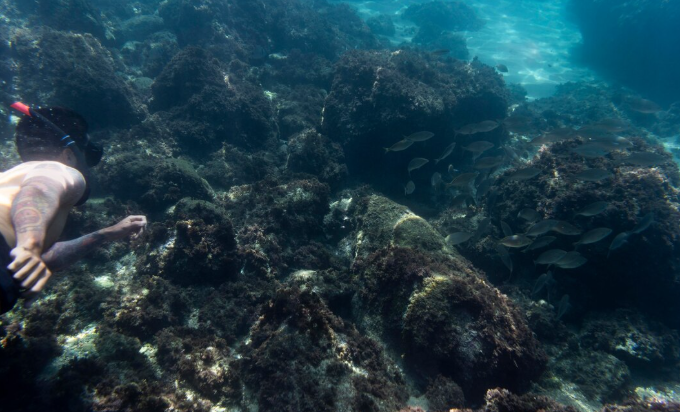
No one anticipated what the cameras eventually showed, transmitted up through hundreds of meters of black water. Bright blue, yellow, and orange mountainside with golden coral towers growing next to formations resembling massive brains. Gorgonian whip coral is teeming with fish. Black coral was surrounded by a cluster of orange sea sponges. Crucially, no one who has witnessed the degradation of the Caribbean’s shallow reefs over the past 20 years has seen any of the gray skeletal damage or white bleaching. The forces destroying everything above it seem to have just abandoned this reef, which is shielded by the seamount’s steep slopes and depth.
Key information — deep-water reef discoveries
| Discovery event | First expedition beyond the shallow waters of Britain’s Caribbean territories — Cayman Islands, Anguilla, and Turks and Caicos — completed March 2026 |
| Lead expedition ship | RRS James Cook, operated by the UK Centre for Environment, Fisheries and Aquaculture Science (CEFAS), running 24 hours a day for six weeks |
| Recording depth reached | Up to 6,000 meters (19,700 feet) — using cameras and equipment subjected to extreme water pressure throughout the survey |
| Reef condition | Described as one of the healthiest, most diverse reefs in the Caribbean region — free from stony coral disease currently devastating shallower Caribbean reefs |
| Notable species found | Pelican eel with glowing pink tail, barreleye fish with tubular upward-pointing eyes, dragonfish with a bioluminescent chin rod, and an unidentified swimming sea cucumber |
| Specimens documented | Nearly 14,000 individual specimens and 290 different types of marine creatures recorded — scientific confirmation of findings still ongoing |
| Comparable discovery | In 2021, Canada’s Lophelia Reef (q̓áuc̓íwísuxv) was found in British Columbia’s Finlayson Channel — the country’s only known living coral reef, located where coral was thought incapable of surviving |
| Amazon reef parallel | A 600-mile sponge and coral reef was discovered at the mouth of the Amazon River in 2016 — spanning over 3,600 square miles of ocean floor |
| Protection urgency | Scientists say the reef is “relatively pristine” but faces threats from climate change and pollution — the race to protect it has already begun |
| Broader implication | Up to 90% of Britain’s unique species are found around its Overseas Territories — these deep-water discoveries may significantly expand that count |
Nearly 14,000 individual specimens and 290 different species of marine animals were recorded throughout the Caribbean territories of the Cayman Islands, Anguilla, and Turks and Caicos during the six-week expedition, which was managed by the UK Centre for Environment, Fisheries and Aquaculture Science and ran around the clock.
The team had to rely on maps that were so out-of-date and riddled with mistakes that whole underwater features were simply absent. In this way, the expedition was as much a scientific endeavor as it was an act of basic cartography, filling in gaps that, considering the ecological significance of the area, most likely ought to have been filled much sooner. In hindsight, the fact that these waters had never been thoroughly investigated seems like a major oversight because up to 90% of Britain’s unique species are found in the vicinity of its Overseas Territories.
Watching footage of a barreleye fish with its tubular eyes fixed upward, searching for animal silhouettes passing between it and whatever dim light filters down from the surface, or a pelican eel flashing a glowing pink tail to entice prey in complete darkness, makes it difficult not to feel something. These animals don’t seem to belong in the same discussion as the vibrant, sunny reefs that most people associate with marine life in the Caribbean. They come from a completely different world, one with its own set of rules, time scales, and definitions of what constitutes a living ecosystem. When the team filmed one specimen, a swimming sea cucumber, they weren’t sure what it was because it was so unusual. They’re still not.
This Caribbean finding fits into a pattern in deep-sea science that has been subtly developing for ten years. A sponge and coral reef spanning more than 600 miles at the mouth of the Amazon River was discovered in 2016 by a Brazilian and American research team. This system spans 3,600 square miles of ocean floor at the edge of the South American continental shelf, where it was previously believed that the turbid, sediment-heavy water of the world’s largest river would completely prevent reef formation. Members of the Heiltsuk and Kitasoo Xai’xais First Nations in British Columbia had been observing large groups of rockfish congregating in a specific fjord for generations in 2021.
In response, scientists sent a submersible into the Finlayson Channel and discovered that lophelia coral, which is typically found in the Atlantic, was flourishing in the north Pacific, where reef survival was thought to be impossible due to the acidity and low oxygen levels of the water. Cherisse Du Preez, the expedition leader, stated, “Everyone was in doubt when we started to see the living corals.” “Then, when we saw the expansive fields of coral in front of us, everybody just let loose.”
All of these findings give the impression that marine science has long been overconfident about what the deep ocean cannot sustain. The deeper the submersibles go, the more the presumptive limits of life are revealed to be human presumptions rather than actual natural boundaries. High acidity, complete darkness, crushing pressure, and cold water were all meant to be decisive arguments against rich biological communities. The sea continues to disagree. It’s possible that the most significant conservation story of the next ten years won’t be about the reefs that scientists have been witnessing die, but rather about the ones that no one was aware existed.
There is a genuine need for protection. Now protected by depth and inaccessibility, the Caribbean reef discovered by the CEFAS team seems immaculate. However, the stony coral disease that is destroying the area’s shallower reefs is spreading, and climate change doesn’t respect depth as it once was thought to. The scientists’ race to record, safeguard, and comprehend these environments before the threats arrive is real. It’s already underway. At last, the maps are being created. Whether the protection arrives quickly enough to be significant is the question.