 By Mari Hansen
 There’s something subtly ridiculous about a wind farm construction site. Concrete pouring into swimming-pool-sized foundations, diesel cranes raising steel towers taller than cathedrals, and trucks sitting idle for hours.
The entire scene is clearly carbon-heavy, noisy, and dusty. However, once completed, the site’s sole goal will be to generate electricity without using any fuel at all. The energy sector has been avoiding an awkward discussion for years because of this contradiction.
| Field | Detail |
|---|---|
| Topic | The Infrastructure Paradox in Green Energy Construction |
| Core Issue | Manufacturing and building renewable infrastructure currently emits record levels of CO₂ |
| Renewable Growth (2022) | 14% year-on-year |
| Global Emissions Trend | Still rising, up 0.8% in 2022 despite clean energy boom |
| Key Sectors Affected | Solar panel manufacturing, wind turbine production, battery storage, grid expansion |
| Largest Hidden Emitter | Steel and cement used in turbine foundations and solar mounting |
| Geographic Concentration | Most upstream emissions occur in coal-dependent manufacturing hubs |
| Carbon Payback Period | Typically 1–3 years for solar, 6–12 months for modern wind turbines |
| Underlying Economic Theory | Jevons Paradox (1865) — efficiency drives consumption, not reduction |
| Time Frame Studied | 2000–2020 across 184 nations |
Ten years ago, no one could have predicted the rapid growth of renewable energy. In 2022, solar capacity increased by about 14% in just one year, closely followed by wind. Investors continue to transfer money, governments continue to raise their goals, and press releases continue to use terms like “milestone” and “record.” However, emissions—the thing that all of this was meant to lower—rose once more. Even so, the increase was only 0.8%. It’s difficult to ignore the discrepancy between the marketing and the math.
There is a structural component to the explanation. Polysilicon is still needed to build solar panels, and the majority of the world’s polysilicon is produced in coal-powered areas. None of the materials used to make wind turbine blades—fiberglass, balsa, and epoxy—manufacture themselves using sunlight. Every gram of steel used in the tower, cement used in the base, and copper used in the nacelle has an emissions tail that is not visible in the glossy brochures.
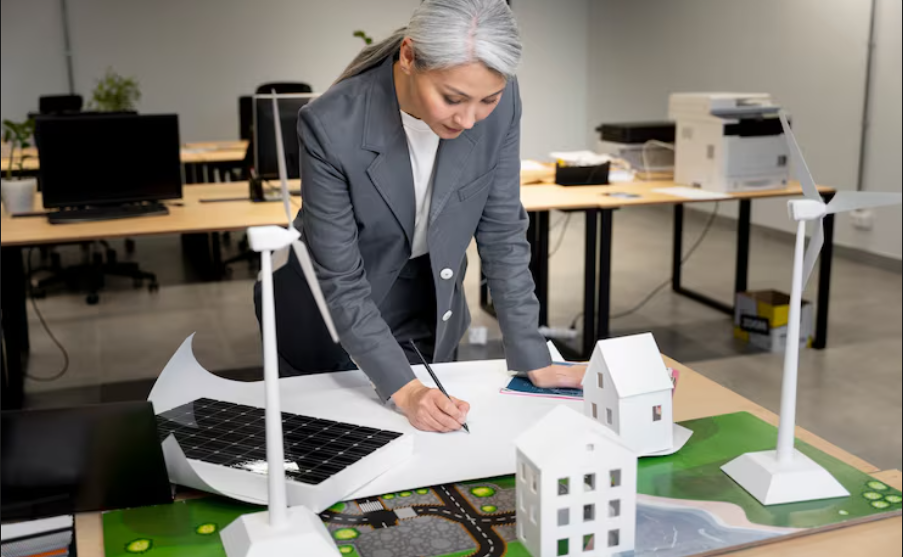
For years, researchers have been pointing this out, primarily in journals that are only read by academics. A few years ago, a life-cycle assessment of a multi-megawatt turbine revealed that upstream emissions—the kind that occur long before a blade ever turns—were frequently silently externalized to the nation that was conducting the smelting that month.
According to engineers I’ve spoken to, nobody wants to include this portion of the transition in a slide deck. Half-jokingly, one of them referred to it as the “carbon hangover.” You spend the next two or three years simply earning your way back to neutral after building the device and paying the upfront emissions cost. That payback window has significantly decreased for solar. With all of its specialized vessels and underwater cabling, offshore wind can extend considerably.
The fact that electrification is occurring more quickly than decarbonization makes the paradox more acute. Global electricity demand increased by roughly 30% between 2013 and 2023, surpassing total energy demand. Clean sources only supplied about 40% of that additional demand. The remaining portion was derived from coal, gas, and oil—fuels that we consistently pledge to phase out. Therefore, rather than taking the place of what is already in place, renewables are being added to the system. It’s an uncomfortable observation, especially for those of us who genuinely want the transition to work.
In 1865, economist William Stanley Jevons noticed that coal markets were acting in ways that engineers were unable to fully explain, which led him to identify the older, more elusive issue. We typically use more of something rather than less when it becomes more efficient. The same arc was followed by computing power. Air conditioning also did. Renewables would not be able to avoid it for any apparent reason. Data centers, AI training clusters, and electric fleets are just a few examples of the new demand brought about by cheaper electricity, which continues to outpace supply.
This is not an argument against construction. Nothing accidentally replaces fossil fuels; the infrastructure must be constructed. However, the public narrative is cleaner than what is actually occurring. As you watch this unfold, you begin to suspect that the next ten years of climate progress will depend more on how honestly we account for building costs than on how quickly we build.