 By Mari Hansen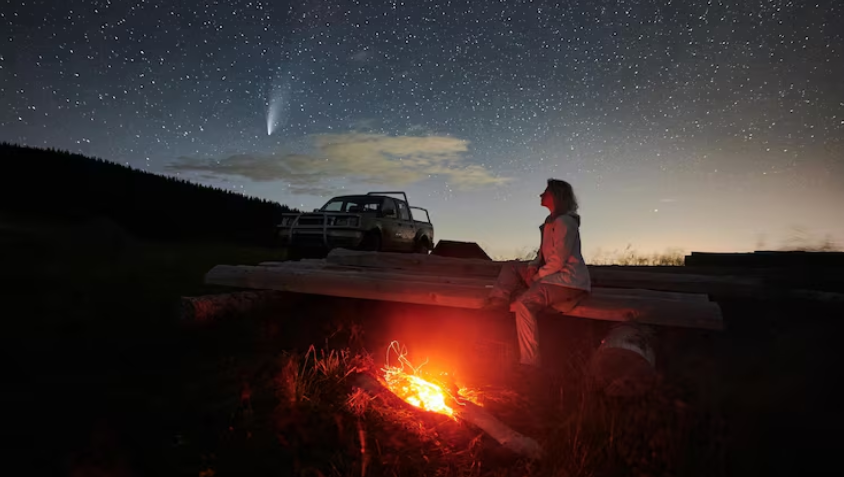
There is something quietly humbling about standing in a field at three in the morning, neck craned back, waiting for a streak of light to burn across the dark. No phone, no noise, just the cold and the sky. The Lyrid meteor shower has been pulling people outside like that every April for — and this is not an exaggeration — over 2,700 years. The Chinese recorded it in 687 BCE. And yet, somehow, it never quite gets the attention it deserves. This year might finally change that.
The 2026 Lyrid meteor shower peaks on the morning of April 22, and the conditions are, by any honest measure, close to ideal. The Moon, which ruins more meteor showers than clouds ever do, is behaving itself this time around. The First Quarter Moon doesn’t arrive until April 24, meaning the sky on the peak morning will be genuinely dark — the kind of dark that lets your eyes adjust fully, lets the fainter streaks register, lets you actually see what you came out to see.
| Detail | Information |
|---|---|
| Event Name | Lyrid Meteor Shower 2026 |
| Peak Date | April 22, 2026 |
| Peak Time (UTC) | 19:15 UTC, April 22 |
| Best Viewing Window | After midnight to pre-dawn, April 22 |
| Active Period | April 15 – April 29, 2026 |
| Expected Rate (Ideal) | 10–15 meteors per hour; surges up to 100/hour possible |
| Parent Comet | Comet C/1861 G1 (Thatcher) |
| Comet’s Orbital Period | ~415 years |
| Radiant Point | Near star Vega, constellation Lyra |
| Moon Interference | Minimal — First Quarter Moon not until April 24 |
| First Recorded Observation | 687 BCE |
| Next Major Outburst Expected | 2042 |
| Meteor Speed | ~50 km/s |
| Reference Website | EarthSky – Lyrid Meteor Shower Guide |
After midnight and before dawn on April 22 is the window. Anyone who’s ever watched a shower through a half-lit sky knows just how much that matters.
Under those clear, moonless conditions, most observers in the Northern Hemisphere can reasonably expect to see somewhere between 10 and 15 meteors per hour at peak. That’s not jaw-dropping by itself, but the Lyrids carry a certain reputation that other showers don’t. They are known for sudden surges — moments where rates can climb unexpectedly toward 100 meteors per hour.
These outbursts aren’t predictable in any precise way, which is part of what makes watching them feel like gambling in the best possible sense. You never quite know what the next hour might bring.
The shower runs from April 15 through April 29, but don’t let that two-week window mislead you. The Lyrids are not a slow-burn affair like some other annual showers. The peak is narrow, concentrated, and over quickly. Missing the morning of April 22 means mostly missing the show. Worth setting an alarm.
The whole thing traces back to a comet most living people will never see. Comet Thatcher — officially designated C/1861 G1 — was discovered on April 5, 1861, by Alfred E. Thatcher of New York City, who spotted it through a modest 4.5-inch refracting telescope. Over the weeks that followed, the comet brightened considerably, eventually becoming visible to the naked eye before fading from view by early summer. It hasn’t been seen since.
The reason is straightforward: Comet Thatcher takes roughly 415 years to complete a single orbit around the Sun. It’s currently somewhere around 110 astronomical units away — 110 times the distance from Earth to the Sun — and still moving outward. It won’t swing back until approximately 2283. Nobody alive today will see it.
What we do get, every April, is the comet’s debris. As Thatcher traces its long elliptical path, it sheds icy material that spreads along its orbit. When Earth crosses that trail each spring, particles the size of grains of sand slam into the upper atmosphere at around 50 kilometres per second. The air in front of them compresses faster than it can move aside, heating to temperatures that cause the meteor’s surface to glow — sometimes reaching 1,600 degrees Celsius.
Most burn up entirely before coming anywhere near the ground. A few particularly robust ones produce what astronomers call fireballs, meteors so bright they outshine Venus. The Lyrids are known for producing them. It’s possible, on the right morning, to see one light up an entire field.
The radiant point — the part of the sky from which the meteors appear to originate — sits near Vega, the bright anchor star of the constellation Lyra. But it’s worth understanding what “radiant point” actually means. The meteors aren’t coming from Vega.
They’re arriving roughly in parallel, the way rain falls in parallel lines, and our perspective makes them look like they’re fanning outward from a single spot. The practical implication is straightforward: once the radiant rises above the horizon, which happens in the northeast around 9 or 10 p.m. for most Northern Hemisphere observers, the show can begin.
But the higher Vega climbs, the more meteors become visible, which is why the hours between midnight and dawn consistently produce the best rates. By that time, the radiant is high overhead, and the meteors rain down from nearly directly above.
Observers in the Southern Hemisphere should know that the Lyrids are, fundamentally, a northern shower. The radiant sits far to the north on the sky’s dome, which means southern viewers see a narrower window and fewer meteors overall. Some will still be visible, but the experience is meaningfully different from a dark-sky site in, say, rural Montana or the Scottish Highlands.
It’s hard not to feel a certain weight when you realize that what you’re watching was first described in writing before Rome was founded. The Lyrid meteor shower is the oldest recorded meteor shower still observed today, and the fact that it still surprises people — still produces fireballs, still triggers unexpected outbursts — suggests there is more going on in that trail of cometary debris than simple predictability allows. The next significant outburst isn’t expected until 2042. Whether this year holds any surprises remains genuinely uncertain, as it always does.
The advice for watching is simple and unchanged by centuries of observation. Find dark sky, get away from city lights, lie on your back, and give your eyes at least 20 minutes to adjust. Bring something warm — April nights carry a chill that most people underestimate.
Look up, wait, and let the sky do the rest. Comet Thatcher won’t return for another 257 years, but its trail will be here next April, and the one after that, stretching forward through time in a way that quietly dwarfs everything happening down here on the ground.