 By Mari Hansen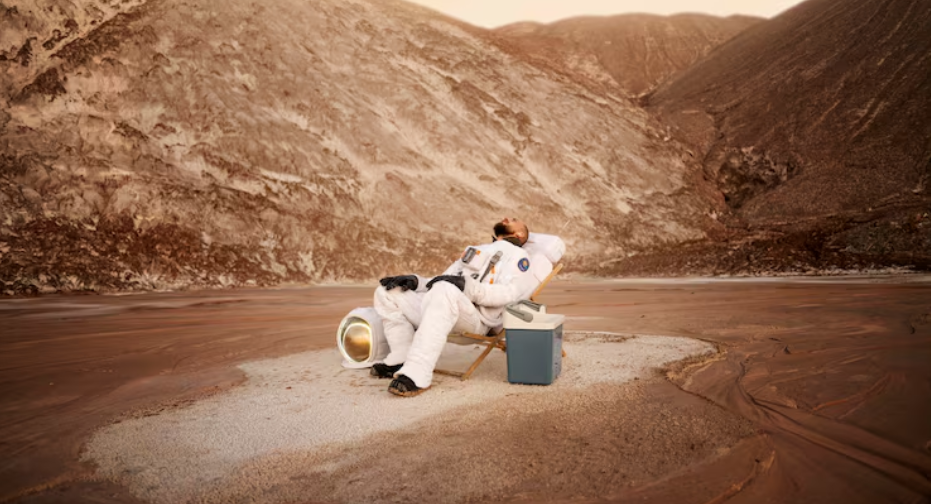
Today, the emptiness of Mars feels almost theatrical. The landscape is covered in rust-colored dust that resembles oxidized snow. The sky above is low and slightly orange, with a thin atmosphere and a lot of suspended dust. It’s difficult to accept that this same planet may have once had rivers, lakes, and possibly even a shallow ocean when you’re standing there or at least visualizing it from rover footage. The obvious question was posed by scientists for decades. What happened to it all?
According to recent research, the solution may be more bizarre than anyone anticipated. Much of Mars’s ancient water may still be present, buried deep underground and concealed inside rocks and mineral structures that were formed billions of years ago, rather than entirely disappearing into space. This type of discovery goes beyond merely providing an answer to a query. It subtly rewrites the whole narrative.
| Category | Details |
|---|---|
| Planet | Mars |
| Key Scientific Question | Where did Mars’ ancient water and atmosphere go? |
| Major Discovery | Large volumes of water may be trapped deep in Mars’ crust or within hydrated minerals |
| Estimated Ancient Water Volume | Enough to form a global ocean hundreds of meters deep |
| Research Contributors | Planetary scientists including Eva Scheller, Michael Manga, and colleagues |
| Major Missions Involved | NASA InSight, Perseverance Rover, MAVEN orbiter |
| Method Used | Seismic data analysis, atmospheric chemistry, mineral studies |
| Scientific Implication | Mars may still contain vast hidden water reserves |
| Timeframe of Water Loss | Mostly between 4.1 and 3.6 billion years ago |
| Reference Source | https://mars.nasa.gov |
Mars seems to have been a completely different planet in the past. The floors of craters were covered in ancient river deltas. The surface is covered in dry channels. Orbital photos of Jezero Crater, the current home of the Perseverance rover, reveal a fan-shaped delta that eerily resembles Earth’s river systems. The geology seems familiar even from space.
It’s difficult to ignore how unremarkable those pictures appear when you watch them scroll by on mission screens. similar to Utah or Nevada landscapes. They’re on a different planet, though.
The case was gradually constructed by earlier spacecraft. Small spheres of hematite, which normally form in water, were found embedded in Martian rock by the Opportunity rover. Subsequent expeditions discovered clays and sedimentary layers, as well as the geological traces of old lakes and sluggish rivers. The evidence accumulated piece by piece. There was water on Mars. Much of it.
According to some models, the planet may have had an ocean that was between 100 and 1,500 meters deep billions of years ago. Perhaps not seas like those on Earth, but enough water to change the landscape and possibly support microbial life. For decades, planetary scientists have been quietly captivated by that possibility alone.
However, approximately 3.6 billion years ago, something occurred.Mars’s atmosphere vanished. or the majority of it, anyway.
The planet was susceptible to solar wind, which is a stream of charged particles from the Sun, because it lacked a strong magnetic field. As a result of the radiation’s gradual removal of atmospheric gases, the barrier that once supported liquid water became thinner.
The narrative appeared simple. Lower pressure resulted from less atmosphere. Water evaporated more readily under lower pressure. Hydrogen leaked into space. Mars became dry. The case is closed. Or so it appeared. However, the figures never quite added up.
Something didn’t seem right when researchers measured the Martian atmosphere’s hydrogen to deuterium ratio, which is essentially a chemical fingerprint of escaped water. The amount of water that the planet seemed to have once contained could not be explained by the amount of hydrogen that had escaped. Sitting inside decades’ worth of data was a silent puzzle.
This is where more recent research came into play. Scientists started mapping the interior structure of Mars in startling detail using seismic data gathered by the InSight lander. Each of the more than a thousand tiny marsquakes that the lander recorded caused seismic waves to travel through the planet’s crust. Something unexpected was revealed by those vibrations.
Approximately 11 to 20 kilometers below the surface, the crust appears to be filled with water-saturated porous rock. Water trapped in microscopic fissures and mineral structures, not exactly flowing oceans.
Researchers estimate that if all of it were brought to the surface, it would cover the planet in an ocean that is one to two kilometers deep.
The story is subtly but significantly altered by that discovery. Mars didn’t just lose its water to space. It’s possible that a significant amount of it was silently absorbed by the planet’s crust, trapped like moisture inside a sponge.
Both processes might have occurred at the same time. A small amount of water leaked into space. Certain minerals underwent chemical reactions with rocks to form hydrated minerals and clays, which permanently stored water molecules within their crystal structures. Earth also does this. However, there is a distinction.
The crust is continuously recycled by tectonic plates on Earth. Water is released back into the atmosphere when minerals reappear through volcanoes after sinking into the mantle. That recycling system is absent from Mars. Ancient and stagnant, its crust remains motionless. The water probably remained in the minerals once it sank.
There is a subtle irony in this tale as it develops over decades of missions. It’s possible that Mars still has water. It just buried it. And that insight leads to a different kind of conjecture.
Large underground water reservoirs could indicate that early Mars was wetter and habitable for a longer period of time than previously thought. If microbial life ever existed, it may have persisted in subterranean aquifers long after the surface became hostile.
Whether those reservoirs are still liquid today is still unknown. Although the evidence is still tentative, conditions deep underground may permit pockets of briny water to endure.
That concept might eventually be tested by future missions. The Perseverance rover is gathering rock samples that will be returned to Earth in the ensuing decades, providing scientists with their first opportunity to directly study Martian geology in labs.
There’s a subtle sense that Mars hasn’t yet told its whole story as the research continues to advance. Every new mission appears to reveal a new piece of the puzzle, sometimes right under the surface. Mars never ceases to amaze us for a planet that appears so motionless from orbit.